Launch sale: −25% on Etsy until 20 NovemberCyber Specials: −30% on Etsy until 1 DecemberInstant download · Print at home · 2 levels in every game

hello@pontusvalstudio.com
Pontusval Studio

Christmas

25 days of mystery: screen-free Christmas countdown ideas for kids

25 screen-free advent ideas for kids: things to make, puzzles, small kindnesses, outdoor missions and cosy evenings, plus tips to keep it easy.
Pontusval Studio6 min read

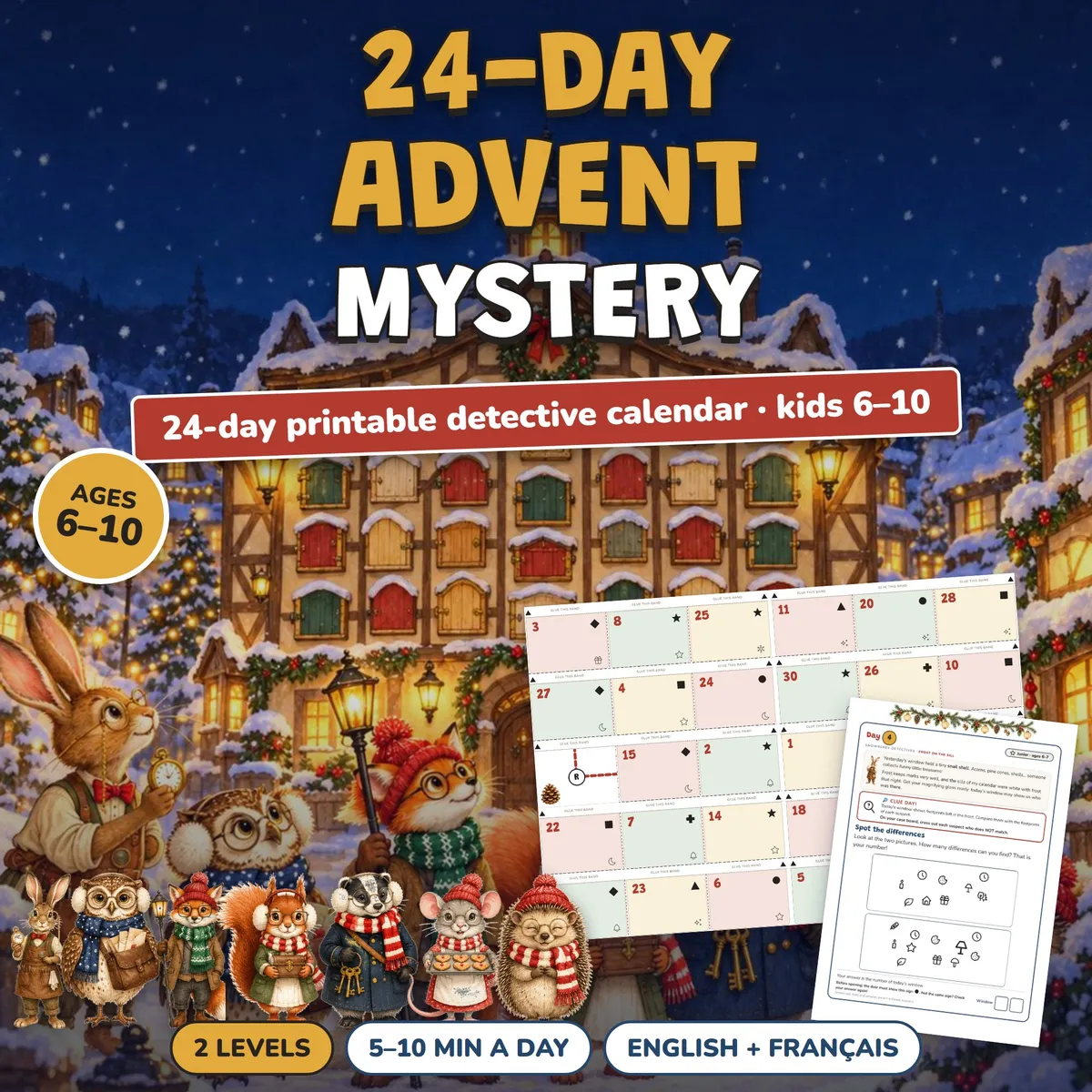
A paper advent calendar with numbered doors and a snowy woodland village

The weeks before Christmas are long when you are seven. A countdown gives each day a small reason to get up, and it does not need chocolate or a screen to work. Below are 25 ideas, one for each day from 1 December to Christmas Day, grouped by type so you can mix and match. None of them needs special equipment, and most take under fifteen minutes.

Before you start: three rules that save December

Keep each day short. A countdown should feel like a treat, not a chore. Five to fifteen minutes is plenty on a school day; save the longer ideas for weekends.

Prepare in batches. Write all 25 activities on slips of paper on one evening in late November, fold them, and put them in numbered envelopes, socks or matchboxes. Then you never have to think about it at 7 a.m.

Plan for missed days. Someone will be ill, or out, or too tired. Decide in advance that two activities can happen on the same day, so a missed day is never a lost day.

Things to make

  1. Paper snowflakes. Fold a square of paper into a triangle three times, cut shapes along the edges and unfold. Tape the best ones to a window.
  2. A family paper chain. Each evening, everyone writes one good thing about the day on a strip of paper. Add the strips to a chain that grows until Christmas.
  3. Salt dough decorations. Mix two parts flour, one part salt and about one part water. Cut shapes, make a hole for the ribbon and bake them low and slow with an adult.
  4. Homemade cards. Fold card, draw, glue and write. Children can make cards for grandparents, teachers or neighbours over two or three days.
  5. A winter village from boxes. Small boxes become houses with drawn windows and doors. Add a new building every few days.
  6. Wrapping paper by hand. Plain brown paper, potato stamps or finger prints, and a pen for little details. It makes even small presents look special.

Puzzles and mysteries

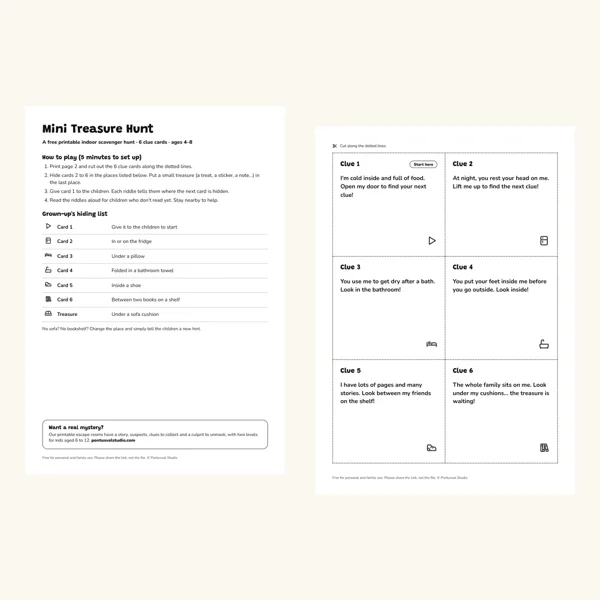
  1. A treasure hunt for today’s surprise. Hide the day’s note or treat and write three simple clues that lead to it, each one pointing to the next hiding place.
  2. Christmas word search or crossword. Draw a grid by hand with words from your family’s Christmas: names, foods, songs.
  3. A secret code message. Write a short message where each letter is replaced by the next one in the alphabet (“HELLO” becomes “IFMMP”), and give the key on a separate slip.
  4. Spot the differences. Draw a simple winter scene twice and change five details in the second one. Older children can make one for their siblings.
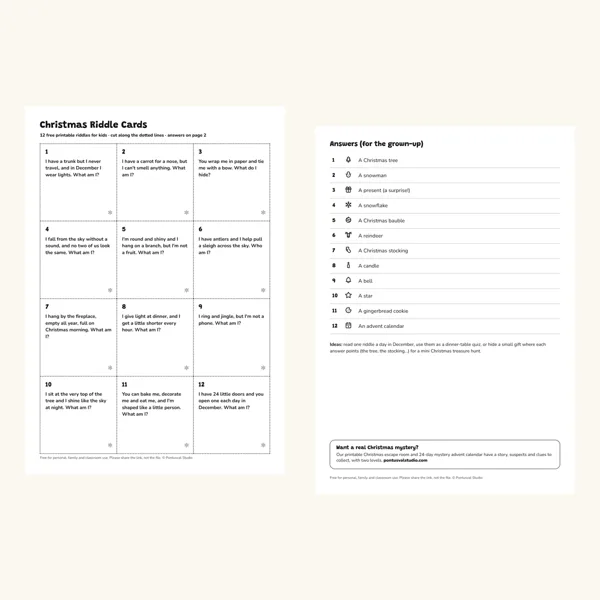
  5. A riddle a day. Pick riddles suited to your child’s age and leave one on the breakfast table. The answer is revealed at dinner.
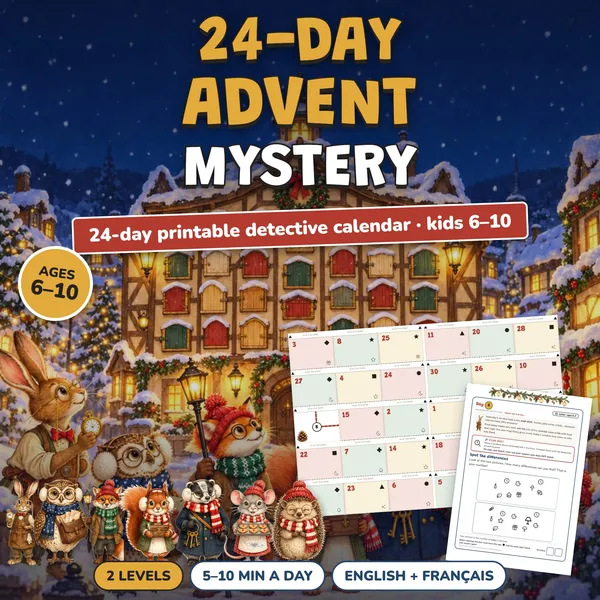
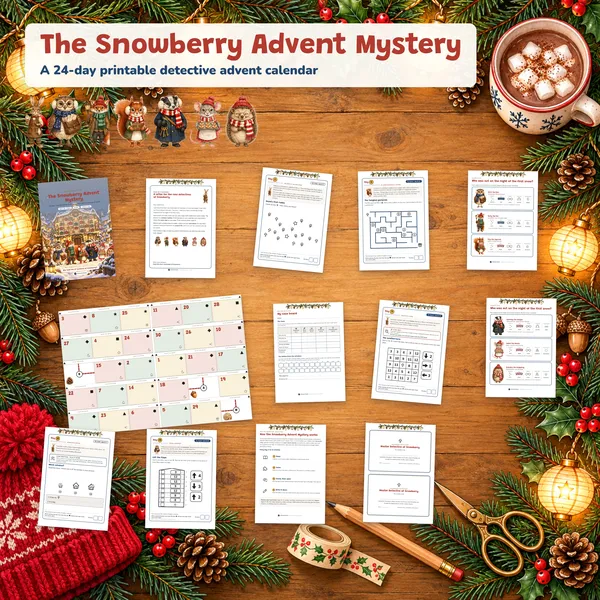
  6. A detective story across December. Instead of separate puzzles, turn the whole month into one mystery, where each day brings a new clue and the culprit is unmasked on Christmas Eve. This is the idea behind our Snowberry Advent Mystery: one short episode and one puzzle a day, a paper advent calendar you build once, and two levels of the same story so siblings of different ages can play together. If you prefer to write your own, keep the cast small (four to six suspects), give out a clue every few days, and keep a “case board” on the fridge where children cross out suspects as they go.

Small kindnesses

  1. A note for the postman or a neighbour. A drawing or a simple “thank you” taped to the door or the bin.
  2. Sort out toys to give away. Each child chooses a few toys in good condition for a charity shop or a family that needs them.
  3. Bake for someone else. Biscuits shared with a neighbour, the teacher or the grandparents.
  4. A phone or video call with a relative. Screen-free does not have to mean people-free: a short call to an older relative, with a song or a joke prepared in advance, counts.
  5. Feed the birds. Hang a pine cone covered in a fat and seed mixture or fill a feeder, then keep a tally of the visitors.

Outside and moving

  1. A winter walk with a list. Write ten things to spot: a red door, a robin, a wreath, a dog in a coat. The first to find them all chooses the pudding.
  2. A torch-lit evening walk. Look at the lights and decorations in your street after dark.
  3. Snow or no snow? If it snows, build something. If not, make a “snowball” game with rolled-up white socks and a basket.
  4. Indoor obstacle course. Cushions to jump over, a chair to crawl under, a line of tape to walk along. Time each lap and try to beat your own record.

Cosy evenings

  1. Read a Christmas story aloud. One chapter a night, or a short picture book. Children can take turns reading a page.
  2. Family games night. Pull out a card game or a board game that has not been played in a while.
  3. A carol concert in the living room. Everyone chooses one song. Pots and spoons are allowed.
  4. Christmas Day: the last envelope. Keep something simple for the last slip: a family photo together, a letter to yourselves to open next December, or the solution to the month’s mystery.

Putting it together: a sample week

A balanced week might look like this: Monday a riddle (two minutes), Tuesday paper snowflakes (fifteen minutes), Wednesday a note for a neighbour, Thursday a puzzle, Friday a torch-lit walk, Saturday salt dough, Sunday a family games night. The short days are the school days; the long ones fall at the weekend.

If you go for a month-long mystery, it can replace the puzzle days. The advantage is that it builds anticipation: children want to know what happens next, not only what is behind the door. In our advent mystery, a day takes roughly five to ten minutes (our estimate), and the parent pages include a one-line summary for each day, so a missed day can be caught up quickly.

A last word for parents

The best countdown is the one you can actually keep up until the 24th. Choose fewer, simpler ideas rather than an ambitious plan that collapses in the second week. Children remember the ritual, the evening walks and the moment the mystery was solved far more than how elaborate each day was.

Written by

Pontusval Studio

An independent studio in Brittany, France, that writes and publishes printable mystery games for children. We test our ideas on paper, at the kitchen table.

  • #advent calendar ideas
  • #screen-free activities
  • #christmas countdown
  • #advent for kids

Shop

Games mentioned in this article

Blog

Keep reading

All articles →